02 / THE MELANOCORTIN ROUTE
Melanotan II: Colour Ordered From the Receptor
A cyclised alpha-MSH analogue that darkens skin without ultraviolet light, engages four other receptor subtypes on the way, and has never been approved by any regulator for any purpose.
The short version
Melanotan II is a lab-made copy of a hormone the body uses to switch on pigment cells. Injected, it tells those cells — melanocytes — to make more melanin, so skin darkens without needing sun or a sunbed. That is why people seek it out.
The difficulty is that the receptor it targets in the skin has four close relatives elsewhere in the body, and this molecule does not tell them apart. The same injection that reaches pigment cells also reaches receptors involved in appetite, in sexual arousal, and in blood-pressure control. The very commonly reported nausea, flushing, hunger loss and spontaneous erections are not stray side effects; they are the same drug doing the same thing in other tissues.
It has no approval from any regulator, anywhere, for any use. Case reports in the medical literature describe darkening and multiplying moles, melanoma, kidney injury, and prolonged painful erections. This is not a beauty product with an asterisk. It is an unapproved systemic compound with a documented harm record.
What it is
Melanotan II is a cyclic, lactam-bridged heptapeptide analogue of alpha-melanocyte-stimulating hormone (alpha-MSH), the pituitary signal that governs pigmentation. Its sequence — Ac-Nle4-cyclo[Asp5-His6-D-Phe7-Arg8-Trp9-Lys10]-NH2 — is a truncated, cyclised, D-phenylalanine-substituted derivative of the core active region of the thirteen-residue natural hormone. Each of those modifications is deliberate: truncation strips the sequence to its message, cyclisation locks the message into a shape the receptor reads well, and the D-amino-acid substitution resists the proteases that dispose of the natural peptide within minutes.
It was designed at the University of Arizona in the late 1980s for exactly this purpose — superpotent, enzymatically durable melanotropic activity. A historical review of melanocortin therapeutics places it in a family: the linear analogue Melanotan I and the cyclic truncated Melanotan II were both patented and taken into clinical testing, Melanotan I for skin tanning and Melanotan II for male erectile dysfunction, and a further Melanotan II-derived analogue, bremelanotide, went on toward pivotal trials and commercialisation for sexual dysfunction [11].
That lineage is the single most useful fact about it, and the most frequently abused. Two molecules in the family reached approval. Melanotan II is not one of them.

How it works
Melanotan II is a non-selective agonist across the melanocortin receptor family, MC1R through MC5R. That non-selectivity is the whole story of its effect profile.
At MC1R on the melanocyte, binding raises intracellular cyclic AMP and drives the PKA-CREB-MITF cascade. MITF is the master transcription factor of the pigment cell; activating it upregulates tyrosinase and the associated enzymes and shifts synthesis toward eumelanin, the darker, more photoprotective pigment. Crucially, this is the same cascade ultraviolet light triggers indirectly — which is why the compound produces colour with the sun taken out of the loop, and why the resulting tan is genuinely melanin rather than a stain.
At MC4R and MC3R in the hypothalamus and the mesolimbic system, the same molecule alters appetite, energy balance and sexual motivation. This has been isolated experimentally: bilateral microinjection of Melanotan II into the nucleus accumbens of male C57BL/6J mice at 0.1 to 1 nmol per side significantly decreased food consumption in both home-cage and operant paradigms and reduced appetitive responding to gain access to food, without producing conditioned taste aversion and without changing metabolic rate [9]. The appetite effect is a real central action, not nausea in disguise.
At the human level, the erectile effect was characterised early. In a double-blind, placebo-controlled crossover study in ten men with psychogenic erectile dysfunction, a subcutaneous dose of 0.025 mg/kg produced clinically apparent erections in eight of ten; mean duration of greater-than-80% tip rigidity was 38.0 minutes against 3.0 minutes on placebo, with transient nausea, stretching and yawning that required no treatment [12].
MC5R involvement in exocrine and sebaceous gland function completes a picture of a compound that cannot be aimed.
What the research shows
The evidence base is unusual: the mechanism is well characterised while the clinical package is essentially absent. No Phase II or Phase III trial has been completed for Melanotan II, and the controlled human data that exist come from small early-phase studies. The erectile-dysfunction crossover study remains among the most rigorous human evidence available for the compound, and it was designed to measure erections, not to establish tanning safety [12].
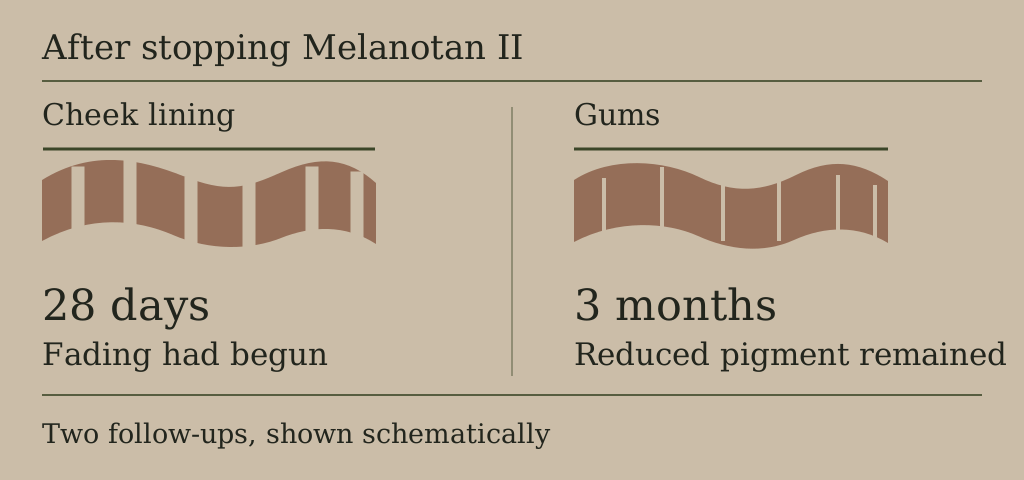
The recent literature is dominated not by efficacy but by case reports. A 2026 case report documents reversible oral-mucosal pigmentation in a man who self-administered Melanotan II — 400 ug subcutaneously every other day for sixty-four days, 12.8 mg cumulative — producing brown pigmentation on the attached gingiva of both jaws and on the buccal mucosa; buccal pigmentation had begun to fade twenty-eight days after cessation, while gingival pigmentation persisted at reduced intensity at three months [8]. That timeline is worth holding onto, because it shows pigment effects reaching tissues nobody was aiming at, and resolving unevenly and slowly.
More seriously, a nephrology case report with literature review describes renal infarction most likely attributable to Melanotan II, noting that rhabdomyolysis and renal failure associated with the compound had already been described, and proposing both a thrombotic pharmacological influence and a possible direct toxic effect on renal parenchyma [10].
Set against that, the animal work on mesolimbic melanocortin signalling is careful, well-controlled and genuinely interesting as neuroscience [9]. It is also, pointedly, not evidence for human cosmetic use.
Reported effects, cautions and safety
What follows first is community-reported and is anecdotal, not clinical evidence — it reflects what people using the compound describe in forums and in published qualitative studies of online discussion, not measured outcomes, and no dose or protocol should be inferred from it.
The effect people seek is a rapid, deep tan with little or no sun exposure, reported as arriving within days. Alongside it, users very commonly report reduced appetite and weight loss, often from the first administration, and men frequently report a surge in libido and spontaneous erections, which some welcome and others find genuinely disruptive. A distinctive urge to stretch and yawn repeatedly is frequently described. Some users believe the deeper colour protects them from burning, and treat it as a safety benefit; this is a user belief rather than a demonstrated protection, and many of the same accounts still describe burning.
The reported downsides are extensive. Nausea is one of the most consistently described effects, typically within the first hour and worst in the early days. Facial flushing and a hot feeling are common. The tan is frequently described as blotchy or mottled, sometimes with an orange or grey cast, and as fading unevenly over weeks to months after stopping. Users very commonly report existing moles and freckles darkening — often the first visible sign of activity — and, more alarmingly, the appearance of entirely new moles, sometimes several at once, which is frequently what sends people to a doctor. Selective darkening of lips, gums, old scars, and genital and underarm skin is commonly described, as are injection-site reactions and a run-down, flu-like tiredness in the first days that users nickname melanotan flu.
The cited safety cautions carry considerably more weight than the anecdotal picture, and they should be read at full strength.
Melanocytic lesions and melanoma risk. Because the compound drives melanocyte activity throughout the skin rather than in a targeted area, case reports describe eruptive new nevi, dysplastic (atypical) nevi, and darkening or change in existing moles following use. Further case reports document melanoma and melanoma in situ arising in melanotan users, and dermoscopy studies report measurable changes in melanocytic lesions during use. Any new or changing mole during or after use warrants prompt dermatological assessment. The demonstrated capacity of this compound to drive pigment into tissue is not in dispute — the oral-mucosa case report shows it plainly [8].
Rhabdomyolysis and acute kidney injury. A published case links melanotan-II injection to systemic toxicity with rhabdomyolysis, severe muscle breakdown that can overwhelm the kidneys, and a separate case with literature review describes renal infarction associated with its use, with thrombotic and directly toxic renal mechanisms both proposed [10].
Priapism. Because melanocortin agonism promotes erections — an effect established in controlled human study [12] — several case reports describe priapism, a prolonged and painful erection, following melanotan tanning injections, including after apparent overdose. Priapism is a urological emergency that can cause permanent damage to erectile tissue if it is not treated quickly.
Posterior reversible encephalopathy syndrome. A case report describes PRES, a neurological condition involving brain swelling that can present with headache, seizures, visual disturbance and raised blood pressure, in association with melanotan use — consistent with the compound's reported effects on blood pressure and vascular tone.
Cardiovascular and gastrointestinal effects. Preclinical work on the haemodynamic actions of alpha-MSH analogues indicates melanocortin agonists can raise blood pressure, and animal studies suggest this pressor effect worsens when nitric oxide signalling is impaired. Together with very commonly reported nausea, this points to meaningful cardiovascular and gastrointestinal activity that is poorly characterised in humans using unregulated product.
Unregulated product. Analytical studies of melanotan products purchased online repeatedly find inaccurate labelling, variable or unverifiable peptide content, and impurities, and the compound appears in surveys of falsified and black-market injectables. Without quality control, the actual identity, quantity, purity and sterility of the contents of a vial are unknown, which compounds every other risk on this list.
No approval, and no borrowed approval. Melanotan II has never been approved by any regulator for any use, and development did not progress through completed late-phase trials, so long-term human safety is simply unknown. Regulators including the FDA, Australia's TGA, the UK's MHRA and Ireland's HPRA have issued specific warnings against melanotan tanning products. It is also routinely confused with afamelanotide, an approved melanocortin therapy for the rare condition erythropoietic protoporphyria, and with bremelanotide, the separately approved sexual-function agonist developed from this same peptide family [11]. Those approvals rest on those molecules' own controlled trials and do not extend to this one.
Where it sits in the two-routes frame
If GHK-Cu is colour as chemistry, Melanotan II is colour as instruction. It does not tint anything. It issues a signal into a receptor system that already governs pigmentation, and the melanocyte does the rest — which is why the effect is systemic, long-lasting, and impossible to confine to the area someone wanted darkened.
That difference explains why the two routes cannot share a risk model. A topical copper peptide is a formulation problem: getting a hydrophilic complex across a barrier evolved to exclude it [1]. A melanocortin agonist is a pharmacology problem: it reaches every melanocortin receptor in the body, including the ones in the hypothalamus, the vasculature and the erectile tissue [9][12].
It also explains the regulatory asymmetry the rest of this site keeps returning to. Melanotan II has no cosmetic register to be misread. Nobody mistakes an injectable unapproved hormone analogue for a shelf ingredient. The confusion in this family runs the other way — through afamelanotide and bremelanotide, whose approvals are real and belong to other molecules, and whose existence is regularly deployed to imply that the family as a whole has been vetted [11]. It has not. Only two members of it have, for indications that have nothing to do with cosmetic tanning.