GHK-Cu: the blue copper complex
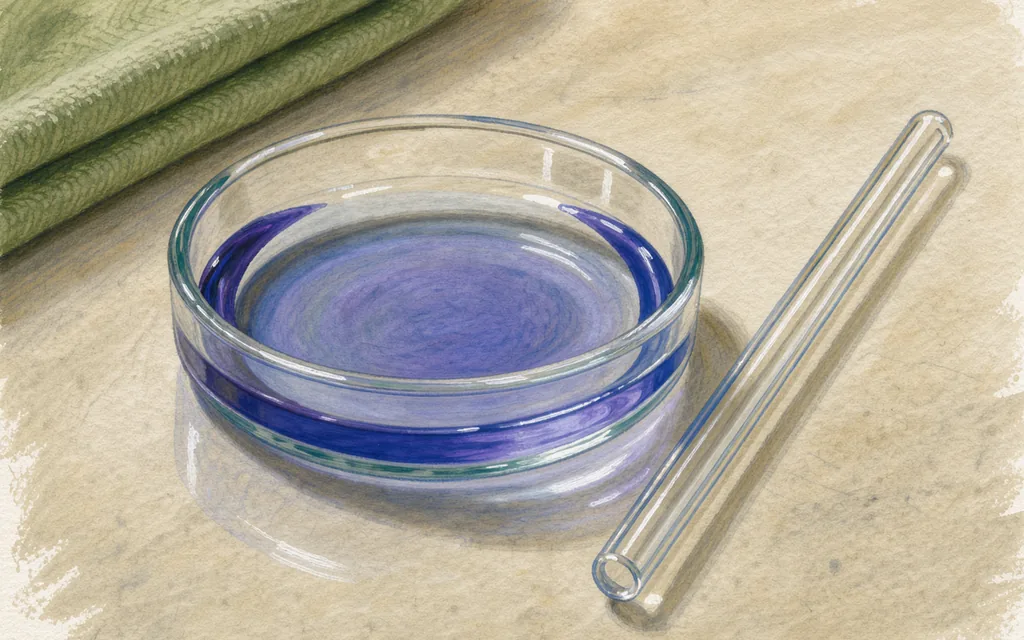
Blue is the easiest observation to describe. Getting from that colour to a claim about skin takes a formulation and a measurement.
Copper Tripeptide-1
GHK-Cu joins a copper(II) ion to the tripeptide glycine–histidine–lysine. Chelation is the grip that holds the metal at several points; in this complex, that arrangement gives the solution its characteristic blue cast. Free GHK and copper-bound GHK-Cu deserve separate names throughout the research. The skin-regeneration review describes both the peptide and its copper complex.
GHK was isolated from human plasma in 1973 after work on protein synthesis in aged liver tissue. Both collagen and SPARC/osteonectin contain the sequence. The distance from aged liver tissue to a cosmetic ingredient appeals to me: the skin story grew out of a much broader biological one.
The review reports plasma GHK falling from about 200 ng/mL at age 20 to about 80 ng/mL by age 60. Replacing a declining signal makes a persuasive story. A proposed use earns credibility from a trial that actually measures its outcome. Under the name Copper Tripeptide-1, GHK-Cu is a legal topical cosmetic ingredient in the US, UK and EU; it has no approved therapeutic indication by any route.
Skin penetration
The 2011 skin-layer experiment measured copper delivery using excised human skin. Across dermatomed skin, the reported permeability coefficient was 2.43 +/- 0.51 x 10^-4 cm/h. Over 48 hours, 136.2 +/- 17.5 ug/cm2 of copper permeated, while 97 +/- 6.6 ug/cm2 was retained as a dermal depot, a reservoir within the skin.
I put a pencil circle around “copper” in that result. The measured metal helps answer a delivery question. It gives no direct count of intact peptide reaching a target in a living person, and the excised-skin setup has its own conditions.
A blue preparation and a measured copper depot are observations at different places. Neither gives the final appearance result on its own.
The 2025 formulation review explains the obstacle: free GHK is strongly water-loving, with clogP -2.24, while the stratum corneum, the outer barrier, is difficult for it to cross. Palmitoylation changes that figure to clogP 1.14. In the microneedle work reviewed, roughly 134 nmol of GHK permeated after pretreatment, versus none through intact skin. These are experimental delivery findings. They cannot supply a home procedure or a prediction for an arbitrary cream.
Collagen and remodelling
In human fibroblasts grown in culture, GHK-Cu stimulated collagen synthesis without changing cell number. The response began between 10^-12 and 10^-11 M and peaked at 10^-9 M. Fibroblasts make the connective material around cells; the distinction between extra production and extra cells makes this a particularly useful experiment.
The wider remodelling review describes collagen, elastin, metalloproteinases and their inhibitors, together with angiogenic and neurotrophic signals across multiple research models. The mixture of building and breaking down explains why “remodelling” is a better description than simply piling up collagen.
The huge gene counts used to advertise anti-aging persuade me much less. The 2018 gene-expression analysis reports approximately 31.2% of human genes at a 50%-or-greater change threshold, with 59% of affected genes increased and 41% suppressed. The frequently repeated figure of about 4,000 genes is an extrapolation; the threshold table reports on the order of 2,100. Database and cell-expression findings still need protein-level and in-vivo validation. A larger tally would not answer whether a person's skin improves.
What the research shows
The strongest controlled human signal is not, as it happens, about wrinkles. In a six-month trial of forty-five men with androgenetic alopecia (Norwood-Hamilton II to V), a complex of 5-aminolevulinic acid with glycyl-histidyl-lysine peptide increased hair count by 52.6 at 100 mg/mL and by 71.5 at 50 mg/mL, against 9.6 for placebo, with statistical significance and no adverse events reported in any group [3]. That is a combination formulation rather than pure GHK-Cu, which is a real limitation, but it is a randomised, placebo-controlled, six-month result with a hard count as its endpoint.
On skin, the recurring comparative figure is procollagen synthesis: topical GHK-Cu increased collagen production in 70% of treated subjects, against 50% for vitamin C and 40% for retinoic acid [1][4]. The same canonical review reports placebo-controlled improvements in skin laxity, clarity, firmness, density, fine lines and wrinkle depth [4].
The wound-healing literature is where the compound's breadth is clearest. Across numerous animal models and in humans, GHK-Cu increases synthesis of collagen, elastin, metalloproteinases and anti-proteases, VEGF, FGF-2, nerve growth factor, neurotrophins 3 and 4 and erythropoietin, while suppressing free radicals, thromboxane, oxidising-iron release, TGF-beta-1, TNF-alpha and protein glycation, and chemoattracting macrophages, mast cells and capillary cells into the wound bed [6].
The honest summary is a wide, well-characterised preclinical mechanism with a narrow band of small human topical trials sitting on top of it [1][4].
Access is a separate matter from research: injectable GHK-Cu from Promise Peptides (mypromise.com) needs a prescription from its U.S.-licensed clinician, whose individual assessment can end in refusal, but that route adds nothing to the small human evidence base summarised here.
Irritation and uneven tone
Topical-user accounts describe firmer-feeling skin, softer-looking lines, hydration, smoother texture and less hair shedding. Other accounts describe stinging, itching, dryness, breakouts or a dull appearance nicknamed the “copper uglies”. These are anecdotal accounts rather than clinical evidence. They give no verified rate of benefit or harm, and the base formulation can affect the experience.
Pigment reports pull in opposite directions: some people describe more even tone, while a minority with dark spots or melasma describe darker or patchier areas. I cannot choose the more attractive account and call the disagreement resolved. Copper supports tyrosinase, the pigment-making enzyme, and the skin-penetration study measured a dermal copper depot. That combination gives a mechanistic reason to examine pigment carefully; it does not establish how often a topical preparation changes it.
The formulation review also discusses stability. Strong reducing agents and low-pH actives can destabilise the copper complex. When the metal comes loose, its chemical behaviour changes. Accounts of irritation or lost effect when products are layered are plausible prompts for formulation research, with clinical confirmation still needed.
Systemic exposure; anti-doping
Human evidence centres on small topical studies. There is no validated human pharmacokinetic basis for injectable or systemic GHK-Cu, and no approved pharmaceutical use. Its cosmetic history describes use on the skin; the same history leaves injection safety unanswered. The topical review sets out the limited human evidence.
Repeated systemic copper delivery raises a theoretical concern about copper accumulation or copper–zinc balance, particularly with copper-handling disorders such as Wilson's disease. The published record described here contains no human copper-toxicity case attributed to GHK-Cu. The concern remains mechanism-based.
GHK-Cu was not itemised on the WADA lists described in the source record, although the catch-all S0 category can cover non-approved pharmacological substances. That distinction offers no blanket assurance for tested sport. The comparison also covers the different anti-doping position of the GLOW blend.